










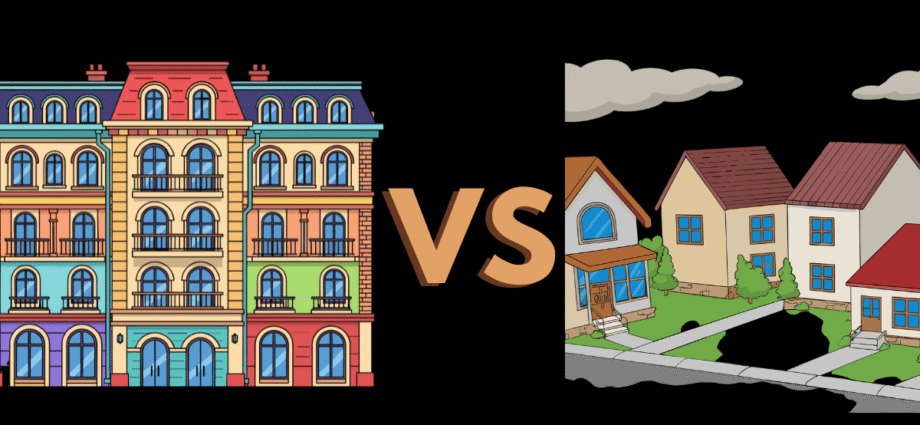
Walk through Paris, Barcelona, Rome, or Vienna, and one thing becomes immediately obvious: people live in apartments, lots of them. Families, retirees, professionals, and even the wealthy all stack neatly above cafés, bakeries, and bookshops.
Now, cross over to the United Kingdom, and the story changes. The ideal home is still a house with a front door, a small garden, and no shared walls. Flats exist, of course, but they are often treated as temporary, second-best, or something you “graduate” from.
This difference isn’t accidental. It’s the product of history, war, law, culture, and planning decisions that shaped how Europeans and Britons understand what “home” really means.
Cities Built Up vs. Cities Built Out

Most continental European cities were born behind walls.
Medieval Paris, Rome, Florence, Barcelona, and Vienna were compact, defensive, and dense. Space inside city walls was precious. As populations grew, cities had only one logical direction: upwards.
Over time, this vertical living evolved into something elegant and highly functional:
- 4–7 storey apartment buildings
- Shops and cafés on the ground floor
- Families living above
- Shared courtyards, stairwells, and streets
Apartments became the default urban home, not an exception.
Britain, by contrast, industrialised early and horizontally. Railways and later cars allowed people to live further from where they worked. Instead of stacking households, developers built terraced houses, then semi-detached homes, then suburbs.
The British city didn’t grow taller. It spread outward.
The War That Changed Everything
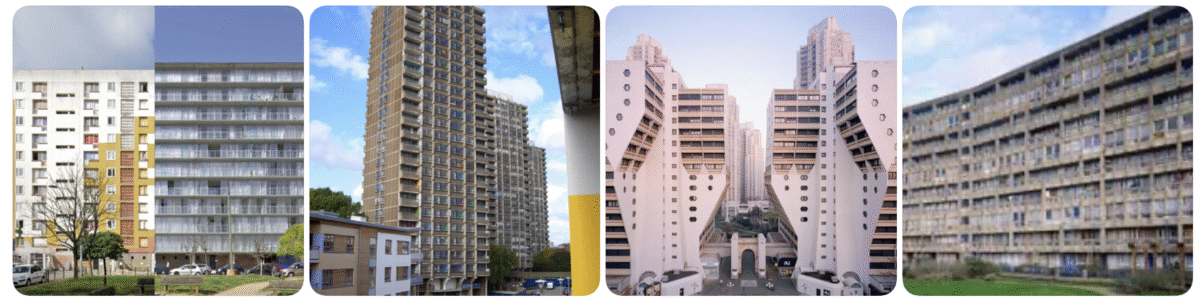
World War II destroyed much of Europe’s housing stock. What came after shaped attitudes for generations.
Continental Europe: rebuilding dignity
In France, Germany, Italy, and Austria, governments rebuilt cities with:
- Mid-rise apartment blocks
- Family-sized units
- Mixed-income neighborhoods
Apartments were designed as permanent homes, not emergency shelters. Middle-class families returned to city centers. Apartment living retained its dignity.
The UK: flats and stigma
Britain also rebuilt, but differently.
- High-rise flats were heavily associated with council housing
- Poor design, isolation, and underfunding followed
- Tragedies and neglect cemented a negative image
Flats became symbols of social failure, while houses became symbols of success.
This stigma never entirely disappeared.
Property Law Quietly Shaped Preferences
Another invisible but powerful factor is ownership.
The UK’s problem with flats
In the UK:
- Houses are usually freehold
- Flats are usually leasehold
- Leasehold often means:
- Service charges
- Ground rent
- Limited control
- Legal complexity
Owning a flat rarely feels as secure as owning a house.
Europe normalised apartment ownership
Most European countries developed robust condominium laws early on. Apartment owners:
- Own their units outright
- Share responsibility for common areas
- Can pass properties to heirs with confidence
A Paris apartment is not “lesser property.” It’s simply property.
Different Ideas of What a Home Is For
In much of Europe, life happens outside the home.
Cafés replace living rooms. Plazas replace back gardens. Parks replace private lawns. The apartment becomes a place to rest, cook, and sleep, not the center of social life.
In the UK, the home is often imagined as a retreat from the world:
- A private garden
- Clear boundaries
- Minimal reliance on public space
This difference is cultural, not just architectural.
Europe optimized for urban life
- Dense cities = excellent public transport
- Walking, cycling, and the metro are the default
- Daily life happens outside the home
- Cafés
- Plazas
- Parks
- Markets
Apartments fit this lifestyle perfectly.
UK leaned into suburban commuting
- Cars and trains supported sprawl
- Suburbs offered:
- Gardens
- Privacy
- “Escape from the city.”
The house became a retreat, not just a shelter.
Planning Laws Locked These Patterns In
Britain’s strict planning system, especially green belts and height restrictions, has made dense urban housing politically difficult.
European cities, on the other hand, generally allow:
- Mid-rise density
- Mixed-use development
- Building “inward” instead of outward
The result?
- Europe builds apartments where people actually want to live
- The UK builds houses further and further away
The Modern Irony
Here’s the paradox.
The UK today desperately needs:
- More housing
- Better urban density
- Walkable, transit-oriented cities
In other words, it needs European-style apartment living.
Yet culturally, Britain still treats apartments as transitional and houses as the ultimate goal.
Europe never had this identity crisis. Apartments were never a compromise; they were simply urban life.
In short:
| Factor | Continental Europe | United Kingdom |
|---|---|---|
| Historical city form | Dense, vertical | Sprawling, horizontal |
| Post-war rebuilding | Apartments for all classes | Flats = social housing |
| Property law | Strong condo ownership | Freehold bias |
| Transport | Walkable, transit-first | Suburban commuting |
| Cultural ideal | Urban family living | House with garden |
| Planning | Density encouraged | House with a garden |
A Final Thought
This isn’t a story about right or wrong housing models. It’s about how history lingers in bricks and mortar.
Europe learned to live closely, vertically, and communally. Britain learned to spread out, retreat inward, and value land ownership above all else.
As housing shortages grow and cities densify, the UK may find itself slowly rediscovering something Europe never forgot: a good apartment can be a real home.
You Might Also Like:
The Economics of Global Beauty Pageants: A Deep Financial Breakdown
Cherry Blossoms After Winter - A Review and Analysis
Top 10 Thai BL Series Released in 2023 That You Need to Binge-Watch in 2024
Corruption in the Philippines Is Not a Moral Failure — It Is an Institutional One
The Myth of Digital Dominance: Why ABS-CBN Is Not the Sole Digital Leader — and How GMA Successfully...
Jin of BTS: A Shining Star and My Ultimate Bias

- From Davao to Alicante: What No One Tells You About Moving to Spain - 24 February 2026
- Reinventing Yourself in Your 30s: Career, Country, and Calling - 22 February 2026
- The Economics of Global Beauty Pageants: A Deep Financial Breakdown - 22 February 2026